


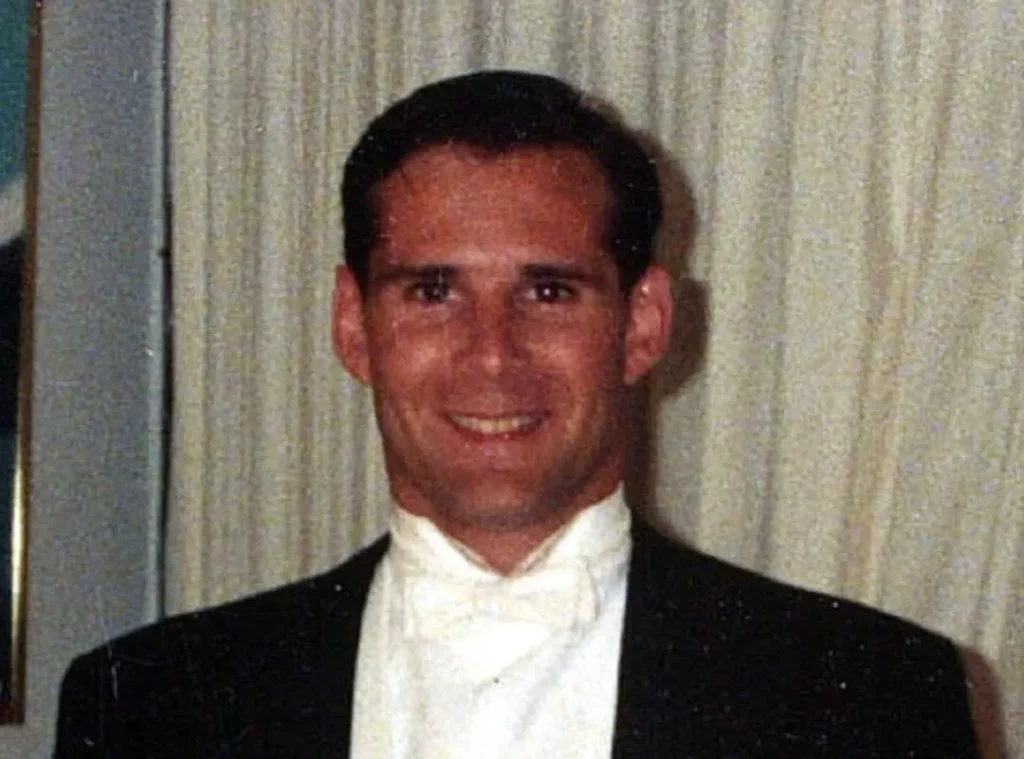
Thomas “Tom” Cressman was 39 years old when his relationship with former royal dresser Jane Andrews ended in murder.
Cressman was a businessman and former stockbroker who lived in Fulham, west London. His killing in September 2000 became one of Britain’s most prominent murder cases because Andrews had spent years working for Sarah Ferguson, Duchess of York. The royal connection dominated headlines, but the criminal case centered on Cressman, the violent attack inside his home and the evidence that led to Andrews’ conviction.
More than two decades later, the legal outcome remains unchanged. Andrews was convicted of Cressman’s murder at the Old Bailey in 2001 and sentenced to life imprisonment. She later lost an appeal, served 14 years in custody before parole and remains subject to a life licence.
Contents
- Thomas Cressman Was a Businessman Living in West London
- Cressman Met Jane Andrews After Her Royal Career Ended
- Their Relationship Became Increasingly Unstable
- The Final Weekend Became the Focus of the Murder Trial
- Tom Cressman Was Killed Inside His Own Home
- Andrews Claimed She Had Acted in Self-Defense
- The Crime Scene Became Critical Evidence
- Cressman Was Left Without Medical Help
- Andrews Left Notes Before Fleeing
- The Murder Triggered a Nationwide Search
- Andrews Sent Contradictory Messages While on the Run
- Police Found Andrews in Cornwall
- Andrews Changed Her Account of What Happened
- The Old Bailey Trial Put Cressman’s Private Life on Display
- Prosecutors Said Jealousy and Rejection Drove the Killing
- The Defense Asked Jurors to Consider Abuse and Fear
- Jane Andrews Was Convicted of Murder
- Andrews Lost Her Appeal
- Cressman’s Family Defended His Memory
- Andrews Served 14 Years Before Release
- What Happened to Thomas Cressman?
- Tom Cressman Remains at the Center of the Jane Andrews Case
Thomas Cressman Was a Businessman Living in West London
Cressman was a businessman with a background in finance and had worked as a stockbroker before developing other commercial interests.
At the time of his death, he lived in a mews property in Fulham, one of west London’s affluent residential areas. He moved in social and business circles that included prominent figures, and reports from the period linked him to business ventures involving former racing driver Sir Stirling Moss.
Cressman was described by relatives as a man with a broad network of family and friends. After his death, his family pushed back against the negative portrayal that emerged during Andrews’ trial and emphasized the impact of the murder on those closest to him.
His life became known to the wider public only after his death, when details of his private relationship with Andrews were examined in court.
Cressman Met Jane Andrews After Her Royal Career Ended
Andrews had spent close to a decade working for Sarah Ferguson before leaving the Duchess of York’s household in 1997.
After leaving royal employment, she moved through a series of jobs and social circles before beginning a relationship with Cressman. She eventually moved into his Fulham home.
The relationship brought together two people with different public profiles. Cressman was not a celebrity, while Andrews carried the residual attention attached to her former royal position.
Their relationship later became the focus of competing narratives. Prosecutors portrayed it as a relationship in which Andrews became angry and resentful because Cressman would not marry her. Andrews claimed the relationship involved abuse and sexual violence.
Those allegations became central to her defense after Cressman could no longer respond.
Their Relationship Became Increasingly Unstable
Evidence presented at the Old Bailey showed that Andrews and Cressman had repeated arguments concerning commitment, sex and other women.
Andrews wanted marriage. Prosecutors argued that Cressman did not intend to make that commitment and that Andrews had become consumed by the prospect of rejection.
She also became concerned about communications between Cressman and another woman. Emails and questions about his sexual behavior became sources of conflict between them.
Andrews later told jurors that she had discovered messages she considered suggestive and claimed Cressman had used prostitutes. She portrayed those issues as part of a pattern that damaged the relationship.
The prosecution accepted that the relationship had problems but rejected the argument that those problems justified what happened next.
The Final Weekend Became the Focus of the Murder Trial
Cressman and Andrews returned from a trip to France in September 2000.
The relationship was under strain. Andrews confronted him over communications with another woman and continued to question the future of their relationship.
Andrews later alleged that Cressman sexually assaulted her during the final period before his death. She claimed that he raped her on September 16.
Cressman was dead when those allegations were made at trial, and his family disputed the picture of him presented by the defense.
The prosecution challenged the timing and development of Andrews’ accusations. It pointed to the fact that she had not made the same claims during her earliest interactions with police.
That credibility dispute became one of several issues jurors had to consider when deciding whether Andrews was a victim acting in fear or a murderer attempting to justify an intentional killing.
Tom Cressman Was Killed Inside His Own Home
Cressman was killed during the early hours of September 17, 2000.
The attack took place in the bedroom of the Fulham home he shared with Andrews.
Prosecutors said Andrews struck him in the head with a cricket bat and then stabbed him in the chest with a kitchen knife.
The knife wound was severe. The blade entered his chest with force and caused fatal internal injury.
The combination of blunt-force trauma and stabbing formed the foundation of the Crown’s argument that this was a deliberate killing.
The prosecution said Andrews had armed herself with two weapons and attacked an unarmed man.
Andrews Claimed She Had Acted in Self-Defense
At trial, Andrews denied murdering Cressman.
She told jurors that she feared him and had taken a cricket bat into the bedroom for protection. She said the confrontation escalated after he woke.
Andrews claimed that she later obtained a kitchen knife and that the fatal stabbing occurred during a struggle.
She denied deliberately driving the knife into Cressman’s chest.
Her defense asked the jury to consider self-defense, accident and alternative verdicts including manslaughter.
The prosecution argued that the medical evidence and the scene did not support that account.
The Crime Scene Became Critical Evidence
What police found inside the Fulham house became one of the most important parts of the prosecution case.
Cressman had suffered both a severe head injury and a deep stab wound.
Bloodstained items were found around the property.
Prosecutors also drew attention to the positioning of a bathrobe cord, which had been tied between a bedroom door and a banister. The Crown argued that Andrews had tried to create the impression that she had barricaded herself because she feared Cressman.
That alleged staging was used to argue that Andrews understood what she had done and was already beginning to construct a defense.
The prosecution also pointed to her movements around the house after Cressman was injured.
Those details mattered because Andrews’ defense depended on portraying the death as the result of panic and fear. Evidence suggesting staging or deliberate movement after the attack weakened that explanation.
Cressman Was Left Without Medical Help
Andrews did not call an ambulance after the attack.
She did not contact police.
Instead, she left the house.
That decision became one of the most damaging facts in the case.
If Andrews believed Cressman was alive or only injured, prosecutors argued, calling for emergency assistance would have been the expected response.
Instead, she drove away from London.
Her decision to leave Cressman behind became part of the prosecution’s case that she knew he had suffered fatal injuries.
Andrews Left Notes Before Fleeing
Before leaving the property, Andrews left written messages.
One was directed toward her family. Another contained claims about Cressman and the way she said he had treated her.
The prosecution interpreted those notes as part of an attempt to explain or justify the killing after it had occurred.
The defense viewed them as expressions of Andrews’ distress.
Jurors had to assess those messages alongside the physical evidence and her later statements.
The notes became significant because they suggested that Andrews was already thinking about how the events would be understood once Cressman’s body was discovered.
The Murder Triggered a Nationwide Search
After leaving Fulham, Andrews became the subject of a police hunt.
Her connection to Sarah Ferguson ensured that the search attracted national attention.
News organizations reported on the disappearance of the former royal dresser while detectives investigated Cressman’s killing.
Sarah Ferguson herself attempted to contact Andrews.
She left voicemail messages urging her former employee to surrender and cooperate with police.
The intervention added to the extraordinary public profile of the case.
Cressman’s death had become more than a local murder investigation. It was now linked to one of Britain’s most recognizable public figures.
Andrews Sent Contradictory Messages While on the Run
During the manhunt, Andrews sent messages that prosecutors later said showed she was attempting to mislead people about what had happened.
At different points, she suggested Cressman had been alive when she left.
She also claimed that she did not understand why people were trying to contact her.
Other messages suggested she knew the seriousness of the situation.
Prosecutors used those contradictions to challenge her credibility.
They argued that an innocent person acting in self-defense would not need to construct changing stories about whether Cressman was alive or dead.
Those messages became another part of the Crown’s argument that Andrews knew she had committed murder.
Police Found Andrews in Cornwall
Andrews was found in Cornwall after several days.
Police located her inside her car, where she had taken a substantial quantity of painkillers.
She was arrested and returned to London.
The manhunt had ended.
The investigation then moved toward the question of what happened inside Cressman’s home and whether Andrews could provide an explanation consistent with the evidence.
Her early accounts created problems for her defense because they differed from the version she later gave at trial.
Andrews Changed Her Account of What Happened
One of the Crown’s strongest arguments concerned Andrews’ changing statements.
At first, she gave accounts that minimized what she knew about Cressman’s condition.
She suggested that she had left him alive.
Later, she admitted that she knew he was dead when she fled.
The prosecution used those changes as evidence of consciousness of guilt.
Andrews’ lawyers argued that trauma, fear and psychological distress affected her behavior.
The jury had to decide whether the inconsistencies were the product of panic or deliberate deception.
The Old Bailey Trial Put Cressman’s Private Life on Display
The murder trial began in 2001.
Because Cressman was dead, the courtroom became the place where competing versions of his character were presented.
Andrews described him as abusive, controlling and sexually violent.
His family rejected that portrayal.
Prosecutors argued that Andrews had created a narrative designed to explain why she had attacked him.
The case therefore became more than a dispute over physical evidence. It also became a struggle over who Cressman had been inside the relationship.
That aspect of the trial proved painful for his relatives because accusations against him could not be answered by Cressman himself.
Prosecutors Said Jealousy and Rejection Drove the Killing
The Crown’s theory focused on motive.
Prosecutors argued that Andrews believed Cressman would not marry her and that she was angry about the breakdown of their relationship.
They also pointed to her jealousy concerning other women.
The prosecution said those factors created the emotional background for the attack.
The killing, in the Crown’s case, was not spontaneous self-defense.
It was the culmination of resentment, jealousy and rejection.
The physical violence supported that argument: a blow with a cricket bat followed by a deep knife wound.
The Defense Asked Jurors to Consider Abuse and Fear
Andrews’ defense offered a different explanation.
She said Cressman had abused her and that she feared him.
Her lawyers argued that her actions occurred within the context of a volatile relationship and that the fatal confrontation did not amount to murder.
The judge allowed jurors to consider self-defense and lesser alternatives depending on how they assessed the evidence.
Psychiatric evidence also became part of the case.
The defense raised issues concerning Andrews’ mental health and later attempted to expand those arguments during the appeal process.
None of those arguments persuaded the jury to reject the murder charge.
Jane Andrews Was Convicted of Murder
On May 16, 2001, the jury returned its verdict.
Jane Andrews was found guilty of murdering Thomas Cressman.
The verdict was reached by an 11-1 majority.
She was sentenced to life imprisonment.
The conviction meant the jury had rejected the core of Andrews’ defense and accepted that Cressman’s death constituted murder.
For Cressman’s family, the verdict provided the legal answer to a case that had exposed his private life to national scrutiny.
Andrews Lost Her Appeal
Andrews later attempted to overturn the conviction.
Her appeal relied in part on new psychiatric evidence and arguments concerning diminished responsibility.
Her lawyers sought to persuade the Court of Appeal that the murder conviction should be reconsidered.
The court rejected that attempt in 2003.
The murder conviction remained in place.
That outcome confirmed the legal finding that Andrews was responsible for intentionally killing Cressman.
Cressman’s Family Defended His Memory
After the trial, Cressman’s relatives spoke about the effect of the case on their family.
They rejected the portrayal of him that had emerged from Andrews’ evidence.
Family members described him as a loved son, brother, uncle, cousin, godfather and friend.
Their statements emphasized the person behind the headlines.
Cressman had become known to millions through a murder trial that concentrated on the worst days of his life.
His family sought to remind the public that his identity extended beyond his relationship with Andrews.
Andrews Served 14 Years Before Release
The legal consequences continued long after Cressman’s death.
Andrews remained in prison for about 14 years.
She escaped from an open prison in 2009 and was recaptured two days later.
She was later granted parole and released in 2015.
Her release did not end the life sentence.
Under the system in England and Wales, Andrews remains on licence for life.
She was recalled to custody in 2018 before being released again in 2019.
The murder conviction has never been overturned.
What Happened to Thomas Cressman?
Thomas Cressman’s life ended inside his own home at the age of 39.
He was struck with a cricket bat and stabbed through the chest.
He received no medical assistance from Andrews before she left the property.
His death triggered a police manhunt, a high-profile trial and years of legal proceedings.
The woman convicted of killing him eventually returned to the community under parole conditions.
Cressman did not get the opportunity to answer the allegations made about him at trial or to explain his own view of the relationship.
The formal legal record remains clear: Jane Andrews was convicted of his murder.
Tom Cressman Remains at the Center of the Jane Andrews Case
The royal connection has always made the case unusual.
Sarah Ferguson’s name drew attention because Andrews had worked for her.
The escape from prison, parole hearings and later television programs kept Andrews in the public eye.
Those elements can obscure the person whose death created the case.
Thomas Cressman was the victim.
He was 39 years old, living in Fulham and involved in a relationship that had reached a point of severe conflict.
On September 17, 2000, he was attacked in his bedroom and killed.
A jury later decided that Jane Andrews had murdered him.
More than 25 years later, that verdict still stands.