


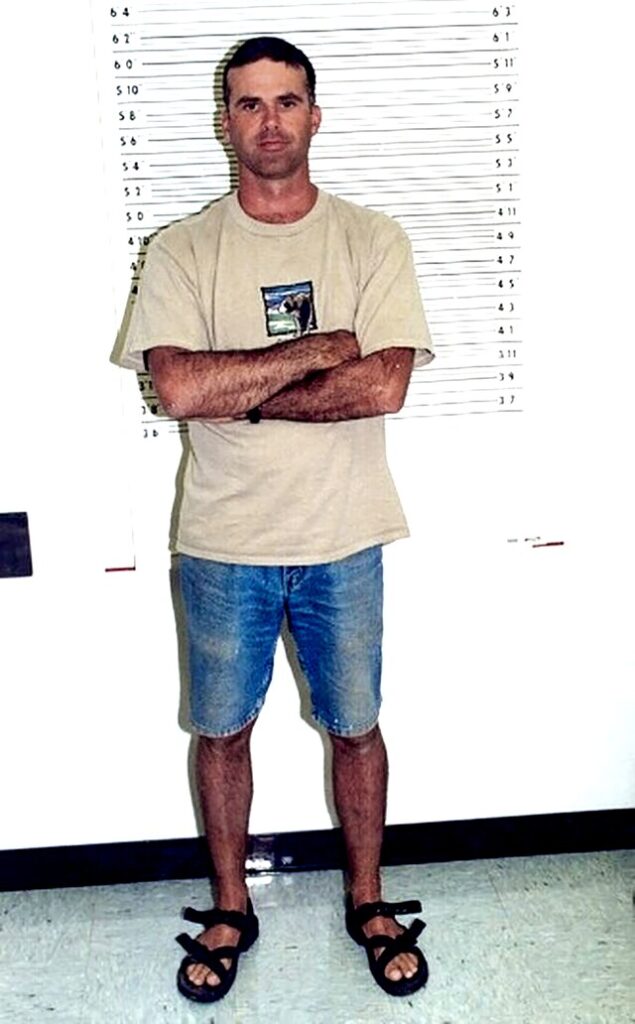
Cary Anthony Stayner is the convicted serial killer responsible for four murders in the Yosemite area in 1999, a case that became one of California’s most notorious multiple-homicide investigations.
Stayner murdered Carole Sund, 42, her 15-year-old daughter Juli Sund, 16-year-old Silvina Pelosso and 26-year-old Joie Ruth Armstrong during a five-month period. He confessed after investigators connected him to Armstrong’s murder, and his admissions revealed that the Cedar Lodge handyman whom police had interviewed during the earlier investigation was responsible for all four deaths.
His story attracted further attention because Cary was the older brother of Steven Stayner, the kidnapping survivor who escaped after more than seven years in captivity and rescued another abducted child. The two brothers came from the same Merced, California, family but became known for opposite reasons.
Today, Cary Stayner remains a California prisoner under a death sentence as well as a separate federal life-without-parole sentence. His state convictions and death sentence survived a major appeal in April 2026.
- “Evil in Eden”: 20/20 Reports on Cary Stayner, the Yosemite Murders and the Stayner Family’s Story of Horror and Heroism August 28 2026
- Who Were The Victims of Cary Stayner? Carole Sund, Juli Sund, Silvina Pelosso and Joie Armstrong
Contents
- Cary Stayner Grew Up in Merced, California
- Steven Stayner’s Kidnapping Changed the Family
- Steven Returned Home as a National Hero
- Cary Said His Murder Fantasies Started Before Steven Was Abducted
- Steven Stayner Died Before Cary Became a Killer
- Cary Stayner Struggled With Mental Health Problems
- Yosemite Became Cary’s Refuge
- Carole Sund, Juli Sund and Silvina Pelosso Arrived at Cedar Lodge
- Stayner Murdered All Three Women
- Police Interviewed Stayner but Did Not Suspect Him
- Authorities Thought Other Men Were Responsible
- Joie Armstrong Became Stayner’s Fourth Victim
- Investigators Trace a Blue International Scout to Stayner
- Cary Stayner Confessed
- Stayner Wanted a Television Movie Made About Him
- Stayner Faced a Federal Case for Joie Armstrong’s Murder
- Stayner Pleaded Not Guilty by Reason of Insanity in California
- The Jury Found Cary Stayner Sane and Guilty
- Cary Stayner Has Two Separate Sentences That Keep Him in Prison
- California Moved Stayner From San Quentin
- Cary Stayner Appealed His Convictions and Death Sentence
- California Supreme Court Upholds Stayner’s Death Sentence in 2026
- Where Is Cary Stayner Now?
- Is Cary Stayner Still on Death Row?
- Cary Stayner Is Not Eligible for Release
- Investigators Have Considered Other Possible Victims
- The Contrast With Steven Stayner Remains Part of Cary’s Story
- Cary Stayner’s Life Is Now Defined by Four Murders
- More “Evil in Eden”
- More Feature Articles
Cary Stayner Grew Up in Merced, California
Cary Stayner was born on August 13, 1961, in Merced, California, to Delbert and Kay Stayner. He was the oldest of five children and grew up with three sisters and his younger brother Steven.
People who knew Cary during childhood remembered a boy whose public personality gave little indication of the crimes he would commit as an adult. Friends recalled riding bicycles, skateboarding and spending time together around Merced. One former friend described him as a “nice guy,” while classmates remembered him as quiet.
Cary also displayed artistic and academic ability. He was placed in accelerated classes and contributed cartoons to his high school newspaper.
His graduating class at Merced High School voted him “most creative.”
His childhood, however, also contained signs of emotional and behavioral problems. Cary suffered from trichotillomania, a compulsive condition that caused him to pull out his hair. Bald patches led him to wear a baseball cap and made him a target for bullying.
Steven Stayner’s Kidnapping Changed the Family
The defining event of Cary’s childhood occurred on December 4, 1972.
His 7-year-old brother Steven disappeared while walking home from school.
Kenneth Parnell and an accomplice had abducted Steven. Parnell kept the boy for more than seven years, gave him the false identity Dennis Parnell and subjected him to sexual abuse.
Cary was 11 when his brother vanished.
Friends later remembered his distress. One recalled hearing stories that Cary would wish for Steven to return home.
The disappearance changed the Stayner family. Steven’s parents lived with the uncertainty of not knowing whether their son was alive, while Cary and his sisters grew up in a household shaped by the missing-child investigation.
Cary later said he felt neglected during the years when his parents focused on Steven.
Steven Returned Home as a National Hero
Steven escaped in 1980 after Parnell abducted another child, 5-year-old Timmy White.
Steven feared Timmy would suffer the same abuse he had endured. He took the boy away while Parnell was absent and brought him to police.
Steven then revealed his own identity.
He returned to Merced at age 14 after more than seven years in captivity.
The story drew national attention. Steven appeared on television and became known across America as both a kidnapping survivor and the teenager who had saved another child.
His experience later inspired the television miniseries I Know My First Name Is Steven.
ABC News reported that Cary appeared withdrawn during some of the attention surrounding his brother’s return. Former acquaintances also described a difficult relationship between the brothers as Steven attempted to reintegrate into the family.
Cary Said His Murder Fantasies Started Before Steven Was Abducted
Steven’s kidnapping has led to questions about whether his experience contributed to Cary’s later development.
Cary himself claimed after his arrest that his fantasies about abducting and killing women began when he was around seven years old.
If true, those fantasies existed before Steven disappeared.
That fact complicates attempts to explain Cary’s later crimes as a direct result of his brother’s kidnapping or the attention Steven received after returning home.
There were other troubling signs in Cary’s youth. He later acknowledged exposing himself to one of his sister’s friends.
People who knew him also remembered difficulty forming relationships with women.
What eventually happened cannot be reduced to one childhood event. Even journalists who examined the brothers in depth cautioned against assuming that Steven’s ordeal caused Cary to become a murderer.
Steven Stayner Died Before Cary Became a Killer
Steven survived his childhood ordeal, married and became the father of two children.
His life ended on September 16, 1989.
Steven died in a motorcycle crash at age 24.
Timmy White, the child whose kidnapping had prompted Steven to escape Parnell, served as one of the pallbearers at his funeral.
Cary lost his younger brother less than a decade after Steven returned home.
The following year brought another violent death into Cary’s life.
His uncle, Jesse Stayner, was shot to death inside the Merced home where Cary had been living with him.
The homicide was never solved.
After Cary’s arrest in 1999, investigators considered whether he could have been involved, but he was never charged with his uncle’s killing.
Cary Stayner Struggled With Mental Health Problems
Cary’s adult life included periods of psychiatric distress.
After high school, he worked in jobs that included installing windows.
People around him later recalled disturbing statements about violence. At one point, Cary described thoughts of driving a truck into his workplace, killing people inside and setting the property on fire.
In 1991, he attempted suicide through carbon monoxide poisoning.
In 1995, he was admitted to a psychiatric hospital after what was described as a nervous breakdown.
He received treatment and was released.
His later criminal trial would include extensive testimony about his mental health, psychological disorders and family history.
Yosemite Became Cary’s Refuge
Cary had a longstanding attachment to Yosemite.
People who knew him said he would travel into the mountains when he wanted isolation.
In 1997, that connection became part of his working life when he obtained a handyman job at the Cedar Lodge in El Portal, near an entrance to Yosemite National Park.
The position gave Stayner regular contact with tourists.
He performed maintenance work around the lodge and had reasons to approach guest rooms.
Two years later, he used that position to gain access to three women whose trip to Yosemite ended in murder.
Carole Sund, Juli Sund and Silvina Pelosso Arrived at Cedar Lodge
In February 1999, Carole Sund traveled to the Yosemite area with her teenage daughter Juli and Silvina Pelosso, an Argentine exchange student staying with the Sund family.
They stayed at the Cedar Lodge.
Stayner saw the three visitors and developed a plan.
According to accounts of the prosecution and his confession, Stayner approached their room using a maintenance problem as a pretext to gain entry.
Once inside, he took control of the room.
Carole, Juli and Silvina became his first three confirmed murder victims.
Stayner Murdered All Three Women
Stayner restrained the victims before carrying out the attacks.
Carole Sund was strangled and shot.
Silvina Pelosso was sexually assaulted and shot.
Stayner removed Juli from the lodge and took her to another location. She was sexually assaulted and killed after her throat was cut.
He then attempted to conceal the crimes.
Carole and Silvina were placed inside the trunk of Carole’s rental car.
The vehicle was burned.
When the three failed to return from their trip, their disappearance produced a major search involving law enforcement agencies across the Yosemite region.
Police Interviewed Stayner but Did Not Suspect Him
Investigators found the burned rental car in March 1999.
The bodies of Carole and Silvina were inside.
Dental records were needed to identify the remains.
Juli remained missing.
Investigators then received an anonymous letter containing a hand-drawn map showing where Juli’s body could be found.
The message included the disturbing statement, “We had fun with this one.”
Police followed the map and recovered Juli’s remains.
Investigators began interviewing employees of the Cedar Lodge.
One of them was Cary Stayner.
He did not become a suspect.
Stayner had little criminal history of significance, appeared composed during questioning and provided investigators with no immediate reason to connect him to the murders.
He remained free.
Authorities Thought Other Men Were Responsible
The murder investigation became complicated by a separate drug investigation.
Authorities began focusing on other suspects and came to believe that the men responsible for the three killings had been taken into custody.
For residents and workers around Yosemite, that suggested the danger had ended.
It had not.
The real killer was still working in the area.
For about five months, Stayner committed no other confirmed murder.
Then he saw Joie Armstrong.
Joie Armstrong Became Stayner’s Fourth Victim
Joie Ruth Armstrong was 26 and worked as a naturalist for the Yosemite Institute.
Her work involved teaching children about nature and the surrounding environment.
On July 21, 1999, Stayner encountered her near her cabin.
He attacked her.
Evidence indicated that Armstrong resisted him.
Her body was found about half a mile from the cabin.
She had been decapitated, and her head was found nearby in water.
This murder produced evidence that the earlier crimes had not.
Witnesses remembered a vehicle parked near Armstrong’s cabin.
It was Stayner’s.
Investigators Trace a Blue International Scout to Stayner
Witnesses reported seeing a blue 1972 International Scout near Armstrong’s residence.
Investigators identified Cary Stayner as the vehicle’s owner.
At first, law enforcement wanted to speak with him as a potential witness.
They already knew who he was because he had been interviewed during the Sund investigation.
When agents attempted to locate him, they discovered he had left the area.
The FBI tracked him to the Laguna del Sol nudist resort in Wilton, California.
Agents John Boles and Jeff Rinek apprehended him on July 24, 1999.
Stayner was taken to Sacramento for questioning.
What followed solved all four murders.
Cary Stayner Confessed
During interrogation, Stayner admitted murdering Joie Armstrong.
He gave investigators information about the killing and described the crime in detail.
Then he admitted something investigators had not expected.
He had also killed Carole Sund, Juli Sund and Silvina Pelosso.
The confession established that investigators had interviewed the killer during the original investigation without recognizing him as a suspect.
Evidence from Stayner’s vehicle strengthened the connection to Armstrong.
His admissions also provided investigators with details about the first three murders that supported his claim of responsibility.
The Yosemite murder mystery had been solved.
Stayner Wanted a Television Movie Made About Him
Stayner displayed an unusual interest in publicity after his arrest.
ABC News reported that he asked a journalist to contact Hollywood producers because he wanted a television movie made about his story.
The request carried significance because his brother Steven’s kidnapping and escape had already been portrayed in a prominent television production.
Steven’s story had brought attention because he survived years of abuse and saved another child.
Cary now appeared to want his own national story.
That contrast became one of the defining themes in accounts of the Stayner brothers.
One sought attention after acts of murder.
The other became famous because of an act of rescue.
Stayner Faced a Federal Case for Joie Armstrong’s Murder
Because Armstrong’s murder occurred on federal land, federal prosecutors handled that portion of the case.
Stayner faced federal charges that included premeditated first-degree murder, kidnapping resulting in death and attempted aggravated sexual abuse resulting in death.
He could have faced a federal death sentence.
Instead, Stayner pleaded guilty.
During his sentencing hearing, he cried and apologized for Armstrong’s murder, saying he wished he could undo what he had done.
The federal court sentenced him to life imprisonment without the possibility of parole.
That sentence alone meant Stayner could never obtain release through the federal system.
The remaining three murders produced a separate California prosecution.
Stayner Pleaded Not Guilty by Reason of Insanity in California
California prosecuted Stayner for the murders of Carole, Juli and Silvina.
His responsibility for the killings was no longer the central dispute.
His attorneys instead argued that his mental condition affected his legal responsibility.
Stayner pleaded not guilty by reason of insanity.
The defense presented evidence about his psychiatric history and psychological conditions.
A psychiatrist testified that Stayner suffered from obsessive-compulsive disorder, mild autism and paraphilia.
His lawyers also raised allegations of sexual abuse within the Stayner family and other evidence relating to mental illness.
The jury was asked to determine whether those conditions satisfied California’s legal standard for insanity.
The Jury Found Cary Stayner Sane and Guilty
The jury rejected the insanity defense.
On August 27, 2002, Stayner was convicted of three counts of first-degree murder with special circumstances as well as kidnapping.
His convictions exposed him to capital punishment.
The case then proceeded to a penalty phase.
Stayner’s attorneys urged jurors to spare his life, pointing to his mental condition and family background.
Prosecutors sought death.
The jury recommended the death penalty.
On December 12, 2002, Stayner was sentenced to death.
For years afterward, he was housed among California’s condemned prisoners at San Quentin State Prison.
Cary Stayner Has Two Separate Sentences That Keep Him in Prison
Stayner’s legal status involves two separate justice systems.
His federal conviction for Joie Armstrong’s murder carries life imprisonment without parole.
His California convictions for the murders of Carole Sund, Juli Sund and Silvina Pelosso carry a death sentence.
This distinction matters when considering his future.
Even if California abolished capital punishment or Stayner’s death sentence were reduced, his federal life-without-parole sentence would remain.
He therefore has no normal path to parole or release.
California Moved Stayner From San Quentin
Stayner spent more than two decades at San Quentin.
California later began dismantling the traditional death-row system at San Quentin and transferring condemned prisoners to other secure institutions.
Stayner was moved to Pelican Bay State Prison in Crescent City, close to the Oregon border.
Court documents from December 2025 and January 2026 list Stayner, CDCR number T-75166, at Pelican Bay State Prison.
Recent California reporting also places him there in 2026.
Cary Stayner Appealed His Convictions and Death Sentence
California death sentences receive automatic appellate review.
Stayner’s case remained before the courts for more than two decades.
His appeal raised numerous challenges involving the investigation and trial.
Among the issues was his interaction with FBI investigators before his confession, including arguments concerning his Miranda rights.
His attorneys also challenged aspects of the evidence and decisions made during the trial and penalty proceedings.
The appeal eventually reached a decisive point in 2026.
California Supreme Court Upholds Stayner’s Death Sentence in 2026
On April 30, 2026, the California Supreme Court upheld Stayner’s convictions and death sentence.
The ruling came almost 27 years after the murders.
The court considered numerous claims of error and concluded that his convictions should stand.
One justice concurred with the conviction and sanity findings while disagreeing with part of the court’s treatment of the penalty phase, but the majority left the death sentence intact.
The ruling was one of the most significant developments in Stayner’s case since his 2002 sentencing.
It means he remains a condemned California prisoner.
Where Is Cary Stayner Now?
As of August 2026, Cary Stayner is incarcerated at Pelican Bay State Prison in Crescent City, California.
Recent reporting based on California prison records confirms his placement there, and legal documents connected to his Supreme Court appeal also identify Pelican Bay as his prison.
The California Department of Corrections and Rehabilitation continues to list Cary Stayner among the state’s condemned inmates.
He remains under the death sentence imposed in 2002 for the murders of Carole, Juli and Silvina.
He also has a federal life-without-parole sentence for murdering Joie Armstrong.
Stayner cannot receive parole from that federal sentence.
Is Cary Stayner Still on Death Row?
Stayner remains legally sentenced to death.
California’s prison system no longer concentrates all condemned male prisoners on the traditional death row at San Quentin, so being housed at Pelican Bay does not mean his death sentence has been removed.
His April 2026 appeal left that sentence intact.
California, however, has not carried out an execution since 2006.
Governor Gavin Newsom imposed an execution moratorium in 2019, and there is no execution date scheduled for Stayner.
His practical situation is therefore that of a prisoner serving life in custody while retaining the legal status of a condemned inmate.
Cary Stayner Is Not Eligible for Release
There is no current prospect that Stayner will return to the community.
His federal sentence alone is life imprisonment without parole.
His California sentence adds a death judgment.
The outcome differs from cases in which a condemned prisoner could become eligible for release if a death sentence were overturned.
For Stayner, removing the California death penalty would not eliminate the federal life sentence.
Barring a successful future challenge to his federal conviction, executive clemency or another exceptional legal development, he will spend the remainder of his life incarcerated.
Investigators Have Considered Other Possible Victims
Stayner confessed to four murders, and those remain his confirmed victims.
Investigators have examined whether he could have committed earlier crimes.
Cases reviewed for possible connections have included the unsolved murder of his uncle Jesse Stayner, the murder of Sharalyn Murphy and the disappearance of Michael Madden.
Authorities also examined other murders and disappearances in areas Stayner knew.
No additional murder conviction has resulted.
For that reason, Cary Stayner should be described as the killer of four confirmed victims, not as the proven perpetrator of the other cases sometimes associated with his name.
The Contrast With Steven Stayner Remains Part of Cary’s Story
Cary’s name cannot be separated from the remarkable history of his younger brother.
Steven Stayner was the victim of a predator.
Cary Stayner became one.
Steven endured more than seven years of kidnapping and sexual abuse before risking his own safety to rescue Timmy White.
Cary took control of vulnerable people and killed them.
The contrast has made the brothers the subject of documentaries, books and television programs for decades.
Yet their shared childhood does not provide a simple explanation for Cary’s actions.
Cary said his violent fantasies existed before Steven was kidnapped, and there is no evidence establishing Steven’s ordeal as the cause of the Yosemite murders.
Cary Stayner’s Life Is Now Defined by Four Murders
Before 1999, Cary Stayner was known within Merced as the older brother of one of America’s best-known kidnapping survivors.
After July 1999, that identity changed.
He became the man responsible for the murders of Carole Sund, Juli Sund, Silvina Pelosso and Joie Armstrong.
His position at the Cedar Lodge placed him in contact with the first three victims. Investigators interviewed him without identifying him as their killer. Five months later, Joie Armstrong’s murder exposed him.
A vehicle placed him near Armstrong’s cabin.
FBI agents found him at a nudist resort.
His confession solved four murders.
Federal court gave him life without parole. California sentenced him to death.
More than a quarter-century after the crimes, that legal outcome remains in place.
Cary Stayner is now incarcerated at Pelican Bay State Prison in Crescent City. He remains on California’s condemned-inmate list, his death sentence was upheld by the California Supreme Court on April 30, 2026, and his separate federal life-without-parole sentence ensures that he has no ordinary path to release.
More “Evil in Eden”
- “Evil in Eden”: 20/20 Reports on Cary Stayner, the Yosemite Murders and the Stayner Family’s Story of Horror and Heroism August 28 2026
- Who Is Cary Stayner & Where Is He Now? 2026 Update & Profile
- Who Were The Victims of Cary Stayner? Carole Sund, Juli Sund, Silvina Pelosso and Joie Armstrong
More Feature Articles
- “Evil in Eden”: 20/20 Reports on Cary Stayner, the Yosemite Murders and the Stayner Family’s Story of Horror and Heroism August 28 2026
- “The Other Side of Paradise”: Dateline NBC Revisits Sandra Galas Homicide August 28 2026
- “A Death in the Stairwell”: 48 Hours Reports on Kevin Davis & Alison Davis Case August 29 2026
- 60 Minutes Reports on “The Cap Arcona” & “Presenting the Kanneh-Masons” on August 30 2026